Contact Information
University of Illinois
A224 CLSL, Box 16-6
600 South Mathews Avenue
Urbana, IL 61801
Research Areas
Biography
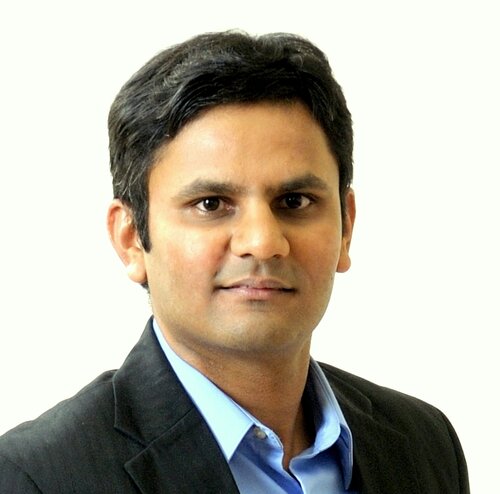
Prof. Prashant Jain began his faculty position at the University of Illinois following his education and postdoctoral training at Georgia Tech, Harvard University, and the University of California Berkeley, where he was a Miller Fellow. He has been a full Professor of Chemistry since 2020 and the G.L. Clark Professor of Physical Chemistry since 2023.
Prof. Jain and his group experimentally and theoretically investigate nanoscale light-matter interactions. They use photon concentration for inducing novel chemical reactivity, powering the synthesis of fuels and chemicals, and dechipering how catalysts function at the atomic level.
Prof. Jain currently serves as a Senior Editor of the Journal of Physical Chemistry and as a member of the Editorial Advisory Boards of JACS and Journal of Chemical Physics. He teaches graduate & undergraduate physical chemistry for which he has received recognition, including the LAS Dean's Award for Excellence in Undergraduate Teaching, the Campus Award for Excellence in Undergraduate Teaching, the School of Chemical Sciences Faculty Teaching Award, and a mention on UIUC's Teachers Ranked as Excellent list for every course he has taught. He currently serves as Associate Head of Undergraduate Instruction in the Department of Chemistry. He has previously served as Associate Head of Major Projects in the Department of Chemistry, Chair of the Chemical Physics PhD program, member of the faculty hiring, tenure, and promotion committee, and the Diversity Advocate for the department. Prof. Jain has published over 125 peer-reviewed journal articles and given over 150 invited/award/keynote/plenary lectures. His research has been cited over 38,000 times and featured extensively in the science media. He is the lead developer of nanoDDSCAT & nanoDDSCAT+, an open-source computational toolkit for nano-optics and photonics, which has been used to launch nearly a million simulations by users across the world.
Research Interests
Prof. Jain has mentored students and postdoctoral research scholars from the following sub-disciplines. For each sub-discipline, research interests are listed.
Experimental Physical and Theoretical Chemistry: Quantum light-matter interactions; superresolution vibrational spectroscopy; mechanisms of energy and charge flow on the nanoscale; plasmonics; photophysics and photochemistry
Condensed Matter Physics: Quantum plasmon resonances; phase transitions on the nanoscale; crystal phases with spin-protected states; superionic conductors.
Materials Chemistry: Nanocrystals; energy chemistry; artificial photosynthesis; nanocatalysis; multielectron catalysis
Analytical Chemistry: Electrochemistry; nanoscale imaging; surface-enhanced Raman scattering spectroscopy
Chemical Engineering: Heterogeneous catalysis; thermal and nonthermal catalysis; sustainable chemical syntheses
Research Description
Light-matter interactions are central in nature, life, and in technology. There are three aspects of the quantum light-matter interface that we study using spectroscopy, microscopy, and theory:
i) We employ the rich interplay between visible light and metal catalysts for selective formation of chemical bonds, catalyzing multielectron chemistry, and manufacturing fuels and energetic chemicals.
ii) We image with unprecedented resolution chemical reactions on surfaces or in nanoparticles and uncover their mechanistic pathways.
iii) We design materials and coax them into exhibiting non-natural optical or optoelectronic phenomena.
In summary, we are learning how to control and harness light as a source of energy and as a means to control the attributes and function of advanced materials.
We are a diverse team with interest and expertise in catalysis, spectroscopy, materials science, and condensed matter physics. The tools we use include single-molecule spectroscopy, nanochemistry, high-resolution electron microscopy, plasmonics, and theory. The systems we investigate range from artificial photosynthetic systems to nanophotonic switches. Our research has had direct impact on the follow areas:
Photosynthesis and Energy Conversion: Driving multielectron fuel-forming reactions by plasmonic light excitation.
Catalysis: Discovering active sites and reaction pathways of catalysts by super-resolution imaging.
Nanoscience: Discovery of unconventional excitations, phases, and transport in nanocrystals.
Prospective postdoctoral researchers, graduate students who have been admitted to a program at UIUC, undergraduate students at UIUC, and collaborators interested in the above research projects are welcome to contact us.
Awards and Honors
Langmuir Lectureship (2026)
Craver Award (2025)
NSF I-ADVANCE Faculty Fellow (2025)
Campus Award for Excellence in Undergraduate Teaching (2024)
LAS Dean's Award for Excellence in Undergraduate Teaching (2024)
Akron American Chemical Society (ACS) Award (2023)
Endowed G. L. Clark Professor of Physical Chemistry (2023)
Elected Fellow of the American Physical Society (2022)
Guggenheim Fellowship, John Simon Guggenheim Memorial Foundation (2022)
University Scholar (2022)
Center for Advanced Studies Associate (2022)
Leo Hendrik Baekeland Medal, American Chemical Society, North Jersey Section (2021)
Kavli Fellow, National Academy of Sciences (2021)
Blavatnik National Award for Young Scientists Finalist Medal (2020,21,&23)
Elected Fellow of the American Association for the Advancement of Science (2020)
Science News Magazine Ten Scientists to Watch, SN10 (2020)
Alumni Research Scholar (2020)
Campus Distinguished Promotion Award (2020)
Defense Science Study Group (2020-22)
Beilby Medal and Prize (2019)
Presidential Early Career Award in Science and Engineering (2019)
Discovery Fund Award, Department of Chemistry (2018)
Fellow of the Royal Society of Chemistry (2018)
Highly Cited Researcher, Clarivate Analytics (2018)
Richard and Margaret Romano Professorial Scholar (2018-)
American Vacuum Society Prairie Chapter Early Career Award (2017)
Campus Distinguished Promotion Award, UIUC (2017)
Center for Advanced Studies Beckman Fellow (2017)
I. C. Gunsalus Scholar (2017-18)
Kavli Emerging Leader in Chemistry and Lectureship, ACS (2017)
Most Cited Researchers in ChemE as per Elsevier Scopus (2016)
3M Non-Tenured Faculty Award (2015)
Journal of Physical Chemistry C Lectureship (2015)
National Science Foundation CAREER Award (2015)
School of Chemical Sciences Faculty Teaching Award (2015)
Alfred P. Sloan Fellowship (2014)
American Chemical Society-Petroleum Research Fund Doctoral New Investigator Award (2014)
Arnold and Mabel O. Beckman Young Investigator Award (2014)
Dupont Young Professor Award (2013)
Teachers Ranked as Excellent by Their Students (Fall 12, 15, 16, 19, 20, 21, 22, 24; Spring 14, 15, 18, 20, 21, 24)
Additional Campus Affiliations
Professor, Materials Science & Engineering
Professor, Materials Research Lab
Affiliate, Physics
Affiliate, IQUIST
Highlighted Publications
Plasmon-assisted electroepoxidations using water, Journal of the American Chemical Society 2026 (link and feature)
Optically generated electric fields influence reaction selectivity PNAS 2024 (link and feature)
Ammonia electrosynthesis with light, Journal of the American Chemical Society 2022 (link and feature)
Distinguishing non-thermal effects from thermal effects in plasmonic catalysis, Journal of Physical Chemistry C 2019 (link)
The LK-99 superconductivity puzzle, Journal of Physical Chemistry 2023 (link and feature)
Watching carbon fixation on a nanoparticle, Nature Communications 2021 (link)
Twins and superionicity, Nature Communications 2019 (link)
Plasmonic photosynthesis, Nature Communications 2019 (link and news)
Watching an order-disorder transition, Nature Communications 2019 (link)
Multi-electron redox plasmonic catalysis, Nature Chemistry 2018 (link and news)
Plasmonic catalysis of carbon fixation, Nano Letters 2018 (link and cover)
Graphene formation in plasmonic catalysis, Nature Communications 2018 (link)
Superionicity on the nanoscale, Nature Communications 2017 (link and news)
Co-operative transitions in nanocrystals, Nature Communications 2013 (link and news)
A regenerable sorbent for hydrogen sulfide, Nature Nanotechnology 2012 (link and news)
Recent Publications
Plasmon-assisted electrochemical epoxidation using water as an oxidant link Lucas Dias Germano, Sajal Kumar Giri, Chloe A. Litts, Francis M. Alcorn, George Schatz*, Susana Inés Córdoba de Torresi*, and Prashant K. Jain*, Journal of the American Chemical Society, 2026, 148 (5), 5368–5377.
Uncovering the thermodynamics of photoelectrochemical separations: viability for low-solar-efficiency materials link Devashish Gokhale, Prashant K. Jain, and Xiao Su*, Nature Communications, 2025, 16, 7284.
Bovine-hemoglobin detection by single-particle plasmon-coupled circular dichroism link Ojasvi Verma, Subhasis Adhikari, Amrita Chakraborty, Prashant K. Jain*, and Stephan Link*, Nano Letters, 2025, 25 (21), 8480–8487.
Identification of the glassy state in nanoparticles by transmission electron microscopy link Francis M. Alcorn* and Prashant K. Jain*, Nature Materials, 2025, 24, 980–982.
Switching of electrochemical selectivity due to plasmonic field-induced dissociation link Francis M. Alcorn, Sajal Kumar Giri, Maya Chattoraj#, Rachel Nixon, George C. Schatz,* and Prashant K. Jain*, Proceedings of the National Academy of Sciences, 2024, 121 (41), e2404433121.
Hydrogen evolution from a spurious source link Chloe A. Litts and Prashant K. Jain*, ACS Energy Letters, 2024, 9, 2736–2738.
Hot electrons in catalysis link Reinhard J. Maurer* and Prashant K. Jain*, Journal of Physical Chemistry C, 2024, 128 (5), 1863–1866.
Solving the LK-99 puzzle link Prashant K. Jain*, Matter, 2023, 6 (12), P4118–4120.
Superionic phase transition of copper(I) sulfide and its implication for purported superconductivity of LK-99 link Prashant K. Jain*, Journal of Physical Chemistry C, 2023, 127 (37), 18253–18255.
The physics of plasmon-driven energy conversion link Prashant K. Jain*, Zee Hwan Kim*, and W. David Wei*, The Journal of Chemical Physics, 2023, 159, 070401.
Watching plasmon-induced nanoparticle Ostwald ripening link Francis M. Alcorn, Maya Chattoraj#, Renske M. van der Veen, and Prashant K. Jain*, Journal of Physical Chemistry C, 2023, 127 (33), 16538–16544
Nanomaterials and sustainability link Gary P. Wiederrecht*, Renaud Bachelot*, Hui Xiong, Konstantinos Termentzidis, Alexandre Nominé, Jier Huang, Prashant V. Kamat, Elena A. Rozhkova, Anirudha Sumant, Michele Ostraat, Prashant K. Jain, Chris Heckle, Jie Li, and Krzysztof Z. Pupek, ACS Energy Letters, 2023, 8 (8), 3443–3449.
Electrochemistry with plasmons link Rachel Nixon (co-first), Enrique Contreras (co-first), and Prashant K. Jain*, Trends in Chemistry, 2023, 5 (8), 605–619.
In situ electron microscopy of transformations of Cu nanoparticles under plasmonic excitation link Francis M. Alcorn, Renske M. van der Veen*, and Prashant K. Jain*, Nano Letters, 2023, 23 (14), 6520–6527.
Time-resolved transmission electron microscopy for nanoscale chemical dynamics link Francis M. Alcorn, Prashant K. Jain*, and Renske M. van der Veen*, Nature Reviews Chemistry, 2023, 7, 256–272.
Primary role of photothermal heating in light-driven reduction of nitroarenes link Prashant K. Jain*, Nature Nanotechnology, 2023, 18 (6), 326–327.